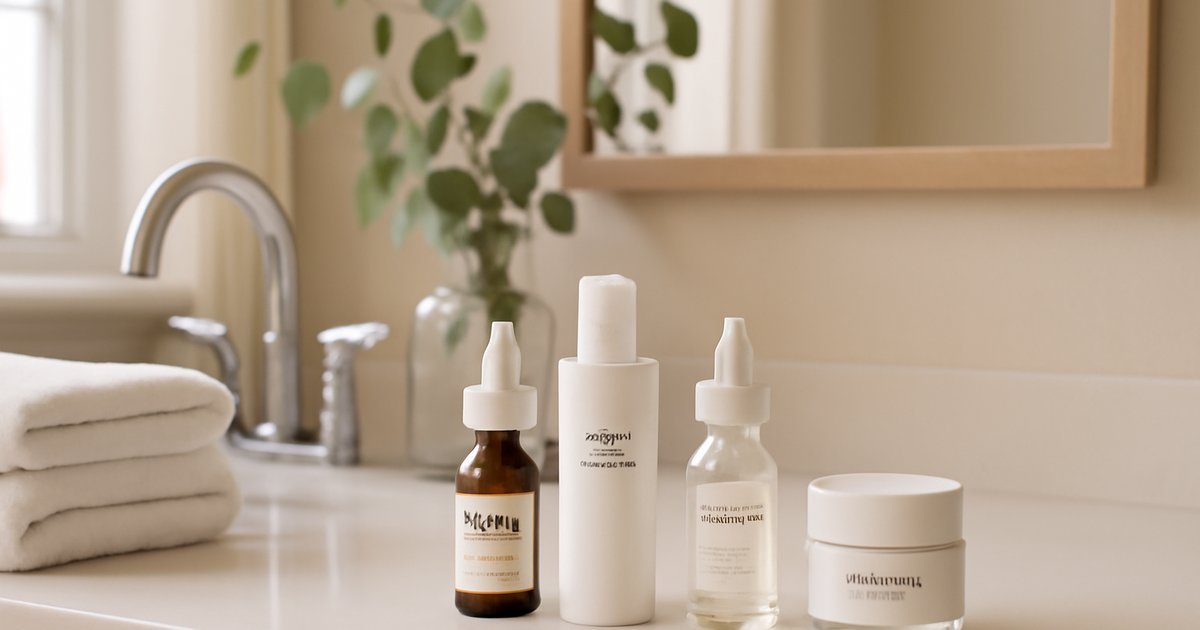
The morning I noticed my first fine line wasn’t a dramatic moment — but it was the one that made me finally take my skincare seriously.
I was 34, running late for work, and catching my reflection under the harsh bathroom light. There it was: a soft crease between my brows that hadn’t been there six months ago. I wasn’t panicked, but I was curious — and honestly, a little motivated. That curiosity sent me down a research rabbit hole that changed my entire routine.
If you’re in your 30s or 40s and wondering whether you should be doing something differently for your skin, the answer is: yes, but it’s not complicated. An anti-aging skincare routine doesn’t require twenty products or a med-spa budget. It requires the right ingredients, in the right order, used consistently.
In this guide, you’ll get a clear, dermatologist-backed framework for building a routine that actually works — one that fits into your real life, not just a glossy magazine fantasy. We’ll cover what ingredients to prioritize, how to layer them, what to skip, and the honest truth about what you can and can’t change with topical skincare.
Why Your Skin Changes in Your 30s and 40s — and What That Means
Understanding what’s happening beneath the surface makes it a lot easier to choose products that actually address your skin’s needs rather than just marketing claims.
Starting in your late 20s, collagen production begins to decline at roughly 1% per year, according to research published in the American Journal of Pathology. By the time you’re in your 40s, that slowdown is visible — skin becomes thinner, less bouncy, and more prone to fine lines and uneven tone. Add in cumulative sun exposure, stress, and hormonal shifts, and you have a perfect storm for visible aging.
In your 30s, the big concerns are usually early fine lines, slight dullness, and maybe some hyperpigmentation from past sun damage. In your 40s, the focus often shifts to deeper texture changes, loss of firmness, and more pronounced discoloration. The good news? Many of the same ingredients address both stages — you’re just adjusting concentration and frequency.
This is also why a skincare routine built for your 20s often stops working in your 30s. Your skin’s cell turnover slows down (from roughly 28 days to 45-60 days as you age), meaning it holds onto dead cells longer and feels more sluggish. Actives that help speed renewal — like retinol and exfoliating acids — become genuinely useful, not just trendy extras.
The Core Ingredients That Actually Deliver Results
Before you buy a single product, it helps to know which ingredients have the strongest evidence behind them. These aren’t based on beauty hype — they’re the ones with real clinical backing.
Retinol (and prescription retinoids) remain the gold standard in anti-aging skincare. A comprehensive review from Mayo Clinic confirms that retinoids are among the few topical ingredients proven to stimulate collagen production and accelerate cell turnover. If you’re new to retinol, start with a low concentration (0.025%–0.05%) two to three nights per week and build up slowly. For a deeper look at how retinol compares to stronger prescription options, this breakdown of retinol vs retinoids covers exactly when to make the switch.
Vitamin C is your daytime antioxidant workhorse. L-ascorbic acid (the most effective form) neutralizes free radicals from UV and pollution, brightens uneven tone, and supports collagen synthesis. It works best at concentrations between 10–20% and at a low pH. The key with Vitamin C is consistency — you won’t see a dramatic overnight change, but after 8–12 weeks, the difference in luminosity is real.
Peptides are often underrated but worth including, especially in your 40s. These short chains of amino acids signal the skin to produce more collagen and elastin. They’re gentler than retinol and can be used morning or night — making them a smart add-on for skin that’s too sensitive for daily retinol use.
Niacinamide rounds out the list with its versatility: it improves texture, fades dark spots, strengthens the skin barrier, and reduces inflammation. It plays well with almost every other ingredient, making it easy to incorporate without worrying about conflicts.
Building Your Morning Routine: Defense Mode
Your AM routine has one primary job: protect your skin from the damage that accelerates aging. Think of it as armor before you face the day.
A Harvard Health Publishing report confirmed what dermatologists have been saying for decades — daily broad-spectrum SPF 30 or higher is the single most impactful step you can take to prevent visible aging. UV radiation is responsible for roughly 80% of visible skin aging (a phenomenon called photoaging). If you’re only going to add one thing to your routine, make it sunscreen. Every. Single. Day. Even in winter. Even when it’s cloudy.
Here’s a simple, effective morning sequence:
- Gentle cleanser — Avoid anything stripping. A low-pH gel or creamy cleanser is ideal.
- Vitamin C serum — Apply to clean skin while it’s still slightly damp. Let it absorb for 60 seconds before layering.
- Niacinamide or peptide serum — Optional but valuable, especially if you’re targeting texture or firmness.
- Moisturizer with ceramides or hyaluronic acid — Locks everything in and preps skin for SPF.
- Broad-spectrum SPF 30+ — The non-negotiable final step. Apply generously and reapply midday if you’re outdoors.
Keep it streamlined. Stacking too many actives in the AM can cause irritation and reduce absorption efficiency. Four to five steps is plenty.
Building Your Evening Routine: Repair Mode
Nighttime is when your skin does most of its regenerative work — cell turnover peaks while you sleep, which is exactly why your PM routine is the ideal window for actives like retinol.
A good evening routine for your 30s and 40s looks like this:
- Oil-based cleanser or balm (if wearing SPF or makeup) — Dissolves sunscreen and product buildup without disrupting your moisture barrier.
- Water-based cleanser — The second cleanse removes any remaining residue. This two-step approach (often called double cleansing) ensures your actives can actually penetrate clean skin.
- Exfoliating acid (2-3x per week) — A leave-on AHA like glycolic or lactic acid improves texture and accelerates cell turnover. Use on nights you’re not using retinol. Check out this complete glycolic acid guide for dosing and frequency tips.
- Retinol (2-4x per week) — The cornerstone of your PM anti-aging routine. Apply a pea-sized amount to dry skin after cleansing. If you experience flaking or sensitivity, try the “sandwich method”: moisturizer → retinol → moisturizer.
- Rich moisturizer or night cream — Look for ceramides, squalane, or shea butter. Your skin loses more water at night (transepidermal water loss increases during sleep), so a heavier formula here makes a real difference.
One thing I learned the hard way: don’t use your exfoliating acid and retinol on the same night. Both are active and effective on their own — combining them frequently leads to irritation and a damaged moisture barrier, which actually accelerates the appearance of aging.
Common Anti-Aging Skincare Mistakes to Avoid
Even well-intentioned routines go sideways. Here are the pitfalls that show up most often — and how to sidestep them.
1. Skipping sunscreen on "indoor days." UVA rays (the ones responsible for aging) penetrate glass. Working from home near a window still means UV exposure. This is one of the most underestimated sources of cumulative skin damage in adults.
2. Starting retinol too aggressively. Jumping straight to a high-percentage retinol every night is a fast track to redness, flaking, and a compromised skin barrier. Consistency at a lower strength beats intensity any day — literally. Begin slowly and increase only after your skin has fully adjusted over four to six weeks.
3. Over-exfoliating in an attempt to "speed things up." More is not more with chemical exfoliants. Daily use of strong AHAs breaks down the skin barrier, making skin more vulnerable to inflammation, sensitivity, and paradoxically, more visible fine lines. Two to three times per week is the sweet spot for most adults.
4. Neglecting the neck and chest. The skin on your neck and décolletage is thinner than your face and ages at a similar rate — but most people stop their routine at the jawline. Extend your serum and moisturizer downward every time. It’s a small habit with a meaningful long-term payoff.
5. Expecting results in two weeks. Most active ingredients take 8–12 weeks to show visible improvement. The biggest mistake is switching products before giving them a real chance to work. Pick a routine, commit to it for three months, then evaluate.
Frequently Asked Questions About Anti-Aging Skincare
Q: Is it too late to start an anti-aging routine in my 40s?
Absolutely not. While prevention is easier than correction, research consistently shows that even adults in their 40s and 50s see significant improvement with consistent use of retinoids, SPF, and antioxidants. It’s never too late to improve skin health.
Q: Can I use niacinamide with retinol?
Yes — and it’s actually a smart pairing. Niacinamide helps buffer retinol’s potential for irritation and supports the skin barrier, making it easier to tolerate retinol more consistently. For the full breakdown, this guide on using niacinamide and retinol together walks you through exactly how to layer them.
Q: Do I need a separate eye cream?
Not necessarily. The skin around the eyes is thinner and more sensitive, but a well-formulated moisturizer with peptides or hyaluronic acid applied gently to the orbital area works well for most people. A dedicated eye cream with caffeine or retinyl palmitate (a gentler retinol derivative) can be a useful addition if puffiness or deeper wrinkles are a primary concern.
Q: What’s the difference between anti-aging products for 30s vs 40s?
In your 30s, focus on prevention and early intervention: SPF daily, a gentle retinol, and antioxidants. In your 40s, prioritize repair and firming: increase retinol strength (with dermatologist guidance), add peptides, and lean toward richer formulas that support a thinning barrier. The framework is similar — the intensity shifts.
Q: Are expensive anti-aging creams actually worth it?
Sometimes, but not always. Price doesn’t reliably predict efficacy. What matters is the active ingredient list, concentrations, and formulation stability. Consumer Reports has noted that many drugstore options — like CeraVe, La Roche-Posay, and RoC — outperform luxury creams in independent testing. Look at ingredients before brand names.
Your Realistic Path Forward
Building an anti-aging skincare routine in your 30s and 40s isn’t about chasing youth — it’s about taking care of your skin with the same intentionality you bring to other areas of your health. The basics are genuinely powerful: SPF every morning, retinol a few nights a week, a solid moisturizer, and one or two targeted actives that address your specific concerns.
You don’t need an overwhelming shelf of serums. You need the right few, used consistently, with enough patience to let them work.
Start with SPF if you aren’t using it. Add retinol next. Build from there. Your future self — the one catching their reflection in six months — will notice the difference.